Intelligent automation for your FM tender
Tender Agent takes you from strategy through business case to tender documents — and turns unstructured asset lists plus project information into standards-compliant LV and LB. With standard templates (LV and LB) and an AI chat you deliver in hours what used to take days — an immediately editable tender specification (Excel) and scope-of-work document (Word), audit-ready.
Speed-to-tender
From days to hours.
Comparability
Consistent structure, fewer questions.
Compliance by design
Grounded in GEFMA and DIN 276.
Strategy, data foundation and business case — before the tender is drafted.
In the project cockpit you first set goals and strategy, pick the right data depth and compare variants financially. Only the chosen variant goes into the tender specification. You compute with your evidenced figures and documented assumptions — Tender Agent invents no market prices.
Goals and starting strategy
Capture the brief, success criteria, time horizon and your organisation's strategy. Justified deviations remain visible; binding guidelines are never overwritten.
Data strategy: top-down, bottom-up or hybrid
Top-down starts with a few building figures like areas, bottom-up uses room and asset lists, hybrid combines both per building and service area. A complete asset list is not required.
Portfolio and scope
Pick buildings and service packages (IFM/TFM) with their own data depth per scope. Unknown quantities stay open; an estimate is never shown as confirmed inventory.
Business case: compare variants
At least two variants for the same scope: annual and total costs, bandwidths and present values over several years, each with price escalation, discounting and investments.
Traceable instead of a black box
Every figure has a source and an assumption. Missing values are flagged rather than treated as zero; stored calculations remain unchanged and can be recomputed.
Handover into the tender
The chosen variant is stored with its rationale and handed into LV and LB. An LV draft stays editable even while the economics are still open.
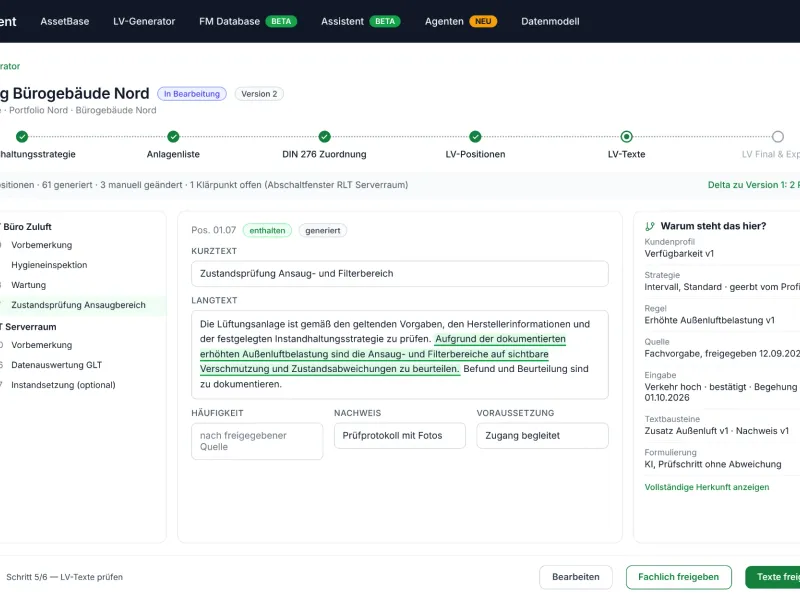
Self-explanatory — despite the depth.
Users navigate Tender Agent on their own, no onboarding required. With Asset Base and LV Generator the platform makes every step traceable — you see what sits behind the automation.
From import to audit-ready export.
Input normalisation
Import of unstructured asset lists (Excel, CSV). AI-driven extraction, entity recognition (assets, trades, quantities, intervals) and duplicate detection.
Rules & standards engine
Derivation of service building blocks from standard LVs and LBs. Standards referencing (DIN 276, VDMA 24186, GEFMA) via a curated knowledge corpus. Parameterisation of SLAs and intervals.
AI generation (RAG approach)
Retrieval-Augmented Generation: the AI draws only on approved sources (templates, standards corpus) and produces a project-specific LV plus its matching LB.
Quality assurance & review
Plausibility checks, versioning and an AI chat for follow-ups like 'increase the inspection interval for HVAC systems to quarterly'.
Exports & handover
Excel export (LV) in your table layout and Word export (LB) in your corporate template — ready for immediate processing.
Governance, security, operations
Role-based access, GDPR-compliant processing and complete logging for an unbroken audit trail.
LV and LB in six steps.
The LV Generator takes you through six clearly separated steps. In each step you see the provenance (profile, strategy, rule, source) of every decision — and can intervene via AI chat.
- 01
Set maintenance strategy
Pick a client profile (compliance and cost, value preservation, availability, data-driven). Derive the strategy per asset class, document deviations with rationale. Compare business-case variants in parallel.
- 02
Load and review the asset list
Import an unstructured list (Excel, CSV) or take over the existing inventory. AI recognises assets, trades, quantities and specifications, flags duplicates and open fields.
- 03
DIN 276 classification
Every asset is automatically assigned its cost group (KG 400 ff., KG 500) — with suggestion and confidence. Correct special cases inline.
- 04
Generate LV positions
Positions arise from assets × service type with quantities, intervals and level. RAG uses only verified templates and the standards corpus.
- 05
Review and release LV texts
Short and long text per position including provenance (profile, strategy, rule, source, text snippets). Refine via AI chat, e.g. 'add emergency-service clauses'.
- 06
LV final and export
Release the version, export LV as Excel and LB as Word in the corporate template — audit-ready and versioned.
From chaotic asset lists to a standards-compliant LV.
This happens in the DIN classification and LV positions steps: your unstructured source data is mapped against the standards knowledge graph.
What customers value in Tender Agent.
Transparent AI process
Asset Base and LV Generator make the full workflow traceable — you see what sits behind the 'magic'.
Structured knowledge base
Layered from cost groups (DIN 276), measures and guidelines (VDMA 24186, DGUV, VDE, VDI 6022) with checklists and operator obligations at asset level.
German hosting
Explicitly welcomed by customers: all data is held on German servers.
Solid LV text foundation
The generated texts cover all relevant aspects — saving routine work and reducing the risk of forgotten items.
Easy to use
Despite the subject-matter complexity, self-explanatory — users navigate the platform on their own, no onboarding.
Economic value
Time saved, standardisation, higher quality and better bid comparability.
From practice.
Technical maintenance — existing portfolio
Situation: 12 buildings, heterogeneous asset lists.
Outcome: Significantly shorter authoring time, fewer questions, clean quantity and interval definitions, audit-ready documentation.
New build — early tender package MEP
Situation: Early phase with incomplete data.
Outcome: Better bid comparability, fewer change orders through more precise scope definition.
Framework contract — recurring services
Situation: Inconsistent LVs per site.
Outcome: Consistent LVs/LBs across all sites, lower maintenance effort, easy scaling.
Ready for the future of FM tendering?
Request a personal demo and see Tender Agent in action.