FM tender specifications – AI-driven and standards-compliant.
Tender Agent is the AI platform that turns asset lists into standards-compliant FM tender specifications based on DIN 276, VDMA 24186 and GEFMA. From data strategy to the finished tender package in Excel and Word – in hours instead of days.
- Hosted in Germany
- GDPR-compliant
- Built by FM practitioners
FM tenders: well-established — with clear room for optimisation.
The process works, but ties up resources. Typical blockers: weak master-data quality, fragmented IT systems and outdated libraries of maintenance texts. Modern tools make it faster, more predictable and data-driven.
Coordination ties up capacity
Many stakeholders and feedback loops stretch timelines and bind expertise that would create more value elsewhere.
Heterogeneous data
Asset data lives in scattered, inconsistent files – usually without proper DIN 276 granularity. A consistent baseline is missing.
Scarce LV know-how
FM expertise for tender writing sits in people's heads and single files instead of a reusable system.
The AI platform for FM tenders — built on real standards knowledge.
Tender Agent combines a structured knowledge base of German FM standards with state-of-the-art AI. The result: complete, standards-compliant tender specifications and scope-of-work documents, ready for direct processing.
Structured knowledge base
Layered from cost groups (DIN 276), measures and guidelines (VDMA 24186, DGUV, VDE, VDI 6022) — every item is normatively grounded.
AI-assisted authoring (RAG)
Asset data becomes LV and LB in minutes — the AI uses only verified sources instead of making things up.
Export & AI chat
Refine via natural-language chat, then export LV as Excel and LB as Word in your corporate template.
The benefits at a glance.
Speed-to-tender
From days to hours — complete tender documents in a single pass.
Comparability
Consistent structure across every tender — fewer bidder questions, clearer offers.
Compliance by design
Grounded in GEFMA and DIN 276 with audit-ready documentation of every step.
Get the strategy right first — then the tender specification.
Tender Agent starts before the LV: you decide how to tender, compare the options financially and hand the chosen variant into the tender.
- 01
Goals and strategy
Capture the brief, the time horizon and your organisation's starting strategy. Justified deviations remain visible.
- 02
Choose a data strategy
Top-down with a few building metrics, bottom-up with room and asset lists, or hybrid per building and service area. A full asset list is not required.
- 03
Compare business cases
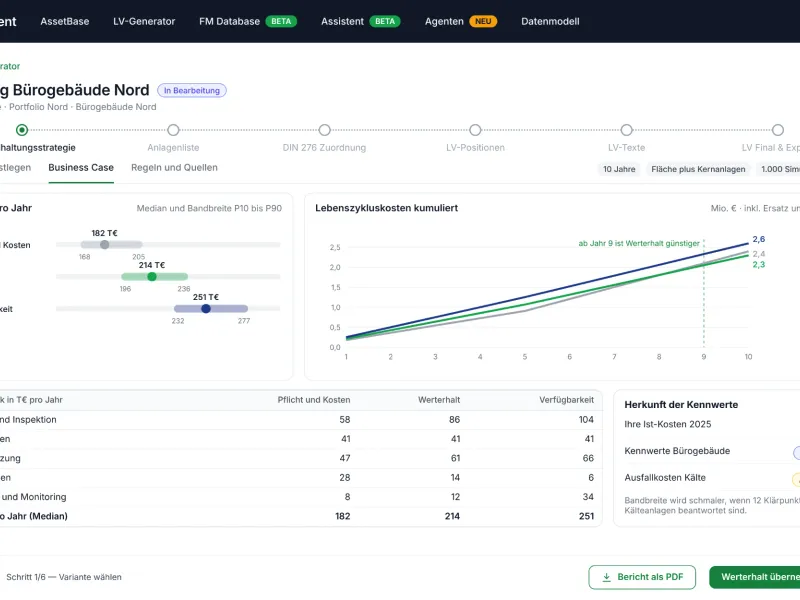
At least two variants for the same scope: annual and lifetime costs, bandwidths and present values over several years — with sources and assumptions.
- 04
Create the tender
The chosen variant goes into the tender specification. After expert review and release, you export the full document package.
What is tender preparation costing you today — and what could you gain?
Set your numbers and see how much time you could reclaim per year — from strategy and variant comparison through to release. The savings percentages are assumptions and can be adjusted.
Set data strategy, compare variants, justify the decision.
Eigene Annahmen. Review and release stay with humans, so savings there are the smallest. Values are placeholders until measured times from pilots are available.
Zeitersparnis von 53 % je Ausschreibung
32
Arbeitstage gewonnen
21.420 €
Wert der gewonnenen Zeit
19 h
Aufwand je Ausschreibung künftig
+13
zusätzliche Ausschreibungen bei gleichem Zeitbudget
Cautious: 170 h · Expected:252 h
Request a demo with your numbersSo rechnen wir
Zeitersparnis = 20 % × Zeitersparnis Strategy and business case (s1) + 25 % × Zeitersparnis Prepare data (s2) + 35 % × Zeitersparnis Draft LV and LB texts (s3) + 20 % × Zeitersparnis Review and release (s4).
Gewonnene Stunden = Ausschreibungen × Aufwand heute × Zeitersparnis.
Wert = gewonnene Stunden × Stundensatz. Ein Arbeitstag hat 8 Stunden.
Model calculation with assumptions, not a commitment. The calculator sizes your internal effort, not the cost of your facility management; that one you compute in Tender Agent's business case with your own evidenced figures. Measured times will follow from pilot projects.
We count your settings anonymously and without cookies to improve the calculator. We do not collect personal data.
More than a tool — a partner for your tenders.
Tender Agent combines the platform with hands-on FM consulting. In compact standardisation projects we develop your company-wide tender standard together with you.
Explore consulting →Common questions
What is a tender specification (LV) in facility management?
A tender specification (LV) describes all required FM services in structured, item-level detail — cleaning, maintenance and inspection services with quantities and intervals. It is the basis for comparable bids. Tender Agent produces the complete LV and the matching scope-of-work document (LB) from your asset data, AI-assisted and standards-compliant.
Which standards does Tender Agent follow?
The knowledge base is layered from DIN 276 cost groups, VDMA 24186, DGUV, VDE and VDI 6022 measures and guidelines, as well as GEFMA — including checklists and operator obligations at asset level. Every LV and LB item is standards-referenced and traceable.
In which formats do I receive my documents?
You get two documents in one pass: the tender specification as an Excel file (in your table layout) and the scope-of-work document as Word (in your corporate template). Both are immediately editable in your usual systems.
Where is my data stored?
Your data is stored and processed on German servers — fully GDPR-compliant, with role-based access and complete audit logging.
Which trades can I create tender specifications for?
Current coverage includes building cleaning (interim, glass and special cleaning), technical facility management and the maintenance and inspection of technical systems (e.g. HVAC, heating, sanitary). The scope is expanding — talk to us about your specific needs.
Do I need a complete asset list?
No. Tender Agent supports three paths: top-down starts with a few building figures like areas; bottom-up uses room and asset lists; hybrid combines both per building and service area. Estimates are never shown as confirmed inventory; unknown quantities stay marked as open.
What does the Business Case in Tender Agent do?
It compares at least two variants for the same scope — with annual and lifetime costs, bandwidths and present values over several years. You compute with your evidenced figures and documented assumptions; Tender Agent invents no market prices. Missing values are flagged rather than treated as zero, and the chosen variant is stored with its rationale.
How much does Tender Agent cost?
Tender Agent is available as a tool subscription. We tailor terms individually — simply get in touch via the contact form.
Does Tender Agent also offer consulting?
Yes. In standardisation projects we jointly build a company-wide tender standard on a DIN 276 basis — a compact fixed-price starter project with workshops and a tested pilot LV. See the consulting page for details.
Ready for more efficient FM tenders?
Request a non-binding demo and see Tender Agent in action on a real example.